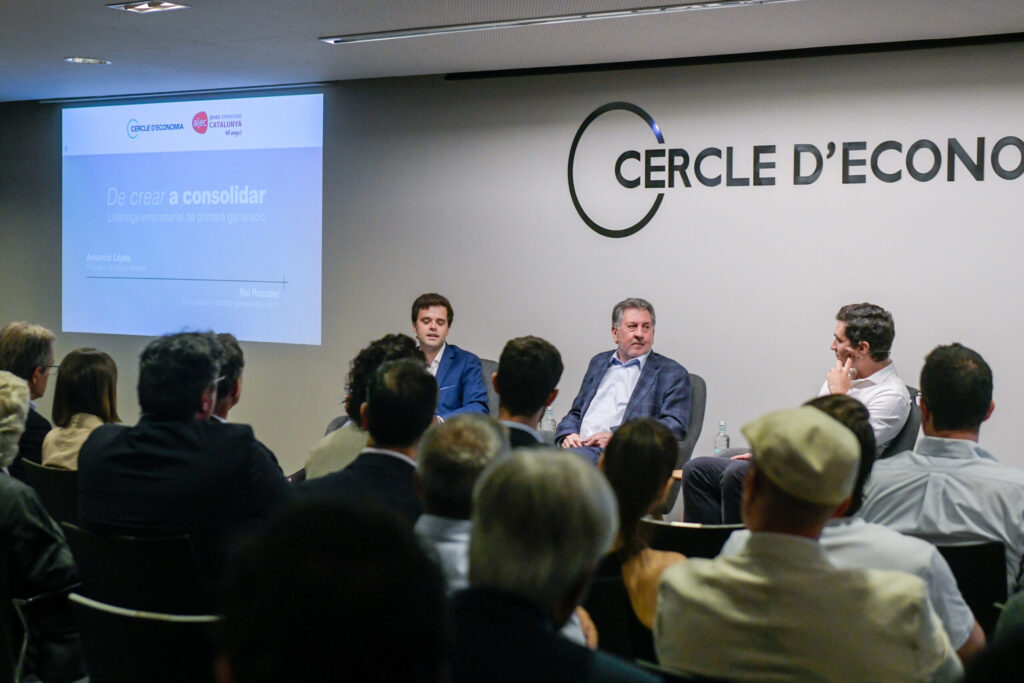
Together with the Catalan Association of Young Entrepreneurs (AIJEC), we organized a new session of the series “From Creation to Consolidation: First-Generation Business Leadership”, with the aim of providing innovative perspectives on business and leadership.
The series brings together two entrepreneurs: one with a long-established business career shaped over several economic cycles, and another with a more recent yet already consolidated and expanding business trajectory. The initiative seeks to encourage reflection on today’s business challenges, generate shared knowledge, and strengthen the business community in a constantly evolving world.
The session featured Amancio López, Chairman of Grupo Hotusa, and Rai Recoder, Co-founder and CEO of Deleito. AIJEC President Vicenç del Mar welcomed attendees, while the discussion was moderated by Víctor Costa, Co-founder of CostaOr Group, member of Cercle d’Economia, and Board Member of AIJEC.
Business Journey and Entrepreneurial Motivation
Both speakers shared the origins of their respective ventures, agreeing that the pursuit of freedom and independence was the main driving force behind creating their own companies, despite belonging to very different generations and moments in time.
Amancio López reflected on his experience since the 1970s, emphasizing the importance of imagination and creativity over academic knowledge: “The ability to create, to imagine, and to inspire is the most important asset in business.” López traced the roots of his entrepreneurial spirit back to his childhood in a small Galician village, where, as he explained, “you learn to value independence and develop creativity.” He recalled starting his business journey in humble circumstances in Galicia and, after two unsuccessful attempts, “the third time was the charm,” ultimately building what has become the current Grupo Hotusa.
Rai Recoder explained that his entrepreneurial mindset emerged at a very young age: by the age of 12 or 13, he was already drafting sales contracts at school. He describes himself as “a pure entrepreneur,” for whom the industry matters less than the purpose of the project: “I don’t mind whether I’m selling communication services or burgers.” In 2018, he founded a corporate communications agency before moving into the restaurant industry with Deleito alongside his current business partner—a former MasterChef contestant. The company has now been successfully operating for nearly four years.
Both agreed that leadership is a continuous learning process based on experience, successes and, above all, learning from mistakes. As Amancio López put it, “Business is all about trial and error,” while Recoder described entrepreneurship as “something irrational.” López also described first-generation entrepreneurs as “the knights-errant of our time.”
Amancio López, Chairman of Grupo Hotusa
Managing Growth and Human Capital
The transition from a small organization to a large company became one of the central themes of the discussion, representing both an operational and a cultural challenge.
Rai Recoder explained that Deleito has grown from three founding partners to a team of 350 people in just four years, and that managing this rapid growth has been the company’s greatest challenge. He acknowledged that absenteeism is particularly high in the hospitality industry and that managing it is especially difficult at the operational levels of the organization.
Amancio López offered the perspective of a company that has been successfully consolidated for almost 50 years through internal training and talent development. Between 2012 and 2014, Hotusa launched an intensive internship training programme, and many of those former interns now hold senior management positions within the group. Although the company does not allow remote working, it offers geographical flexibility through a network of 20 to 25 offices across Spain, Europe and the Americas.
Despite the differences in size and stage of development of their companies, both speakers agreed that corporate culture should be an extension of the founders’ personal values in order to remain authentic and credible. “A company should be an extension of who we are as people,” Recoder concluded, while López stressed the importance of shared values, transparency and ethics as essential pillars for fostering commitment and long-term engagement among employees.
Brand Strategy and Competitiveness
The ability to build a strong brand emerged as the key differentiating factor for competing successfully.
Rai Recoder explained that Deleito has positioned itself among the top five burger brands in Catalonia despite competing against companies with marketing budgets up to twenty times larger. According to Recoder, the strategy rests on three pillars: efficient operations (fast service), a high-quality Mediterranean-inspired product, and creative communication that builds community and a sense of belonging by linking the brand to culture and sport. He also explained that the brand primarily targets consumers aged between 18 and 35 through digital channels, influencers and music festivals.
Amancio López focused on scale and long-term competitiveness. In his view, true competitiveness means continuously adapting while maintaining efficiency in the short, medium and long term. “A company’s first objective is to survive, no matter what,” he said. “In the short term, the key is to be efficient and competitive—to work harder and better than your competitors. In the medium term, you aspire to leave a lasting legacy. That has always been the story of the traditional entrepreneurial class.” López also highlighted the crucial role played by Spanish and international banks in financing the productive economy.
Rai Recoder, Co-founder and CEO of Deleito
Reflections on the Economic and Institutional Environment
Both entrepreneurs expressed concern about the high mortality rate of small businesses and the difficulty they face in growing into medium-sized and large companies.
Amancio López criticized excessive bureaucracy in Europe and suggested that artificial intelligence could become a valuable tool for reducing administrative burdens. He also warned that “the productive economy is facing difficulties” and that “the financial economy currently prevails.” According to López, businesses are the true creators of wealth and their freedom must be protected from excessive bureaucracy and regulation. For this reason, he argued, greater efforts are needed to explain that business profits are a means to reinvest, grow and create jobs—not an end in themselves. He noted that Grupo Hotusa has never distributed dividends because its sole priority has always been ensuring the company’s long-term sustainability.
Rai Recoder added that becoming an entrepreneur and building a business is far more difficult than it appears because “the system is designed to discourage people from making that decision,” and that there is no single formula that can be learned in business school—each entrepreneur must find their own path.
The speakers concluded that, despite the challenges posed by today’s environment, entrepreneurship requires optimism, a long-term vision and a strong moral foundation. As Amancio López summed up, if he had to choose just one key factor for success, it would be optimism. The event concluded with the reminder that every great achievement begins with a project, an idea and, above all, an ideal capable of inspiring an entire organization.